Share This Project


European Journal of Homelessness: Homelessness and Street Homelessness in England
Outline of the study
This paper provides a comprehensive overview of homelessness and street homelessness trends, causes, and policy responses in England from a government perspective. It examines how improvements in data collection and evidence-based evaluation have informed recent policy-making, reviews findings from major government programme evaluations, and outlines future plans to link research and administrative data, to better understand what works in tackling homelessness.
Findings in brief
- In 2019/2020, 288,470 households approached local authorities in England for assistance with housing problems. Of these, 148,670 households were assessed as 'threatened with homelessness' and 139,800 as already 'homeless'
- The introduction of the Homelessness Reduction Act 2017 increased the number of households owed a homelessness relief duty by 15%, of which 71% is attributable to single adult households
- 51% of households owed homelessness duty have one or more support needs.
- Main causes of homelessness relate to end of private rental tenancy (29%) and friends/family no longer able to accommodate (24%).
- In March 2021, 95,450 households were in temporary accommodation. This figure is attributed partly to temporary accommodation arrangements for people experiencing rough sleeping during the COVID-19 pandemic
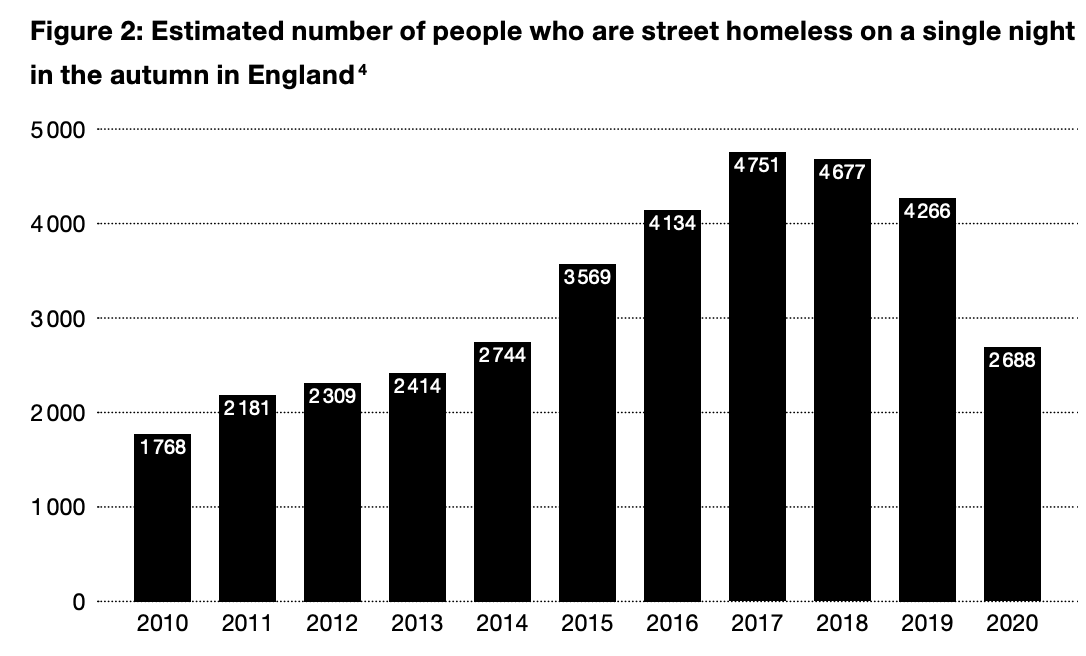
- Street homelessness, as recorded in single night snapshots, decreased from a peak of 4,677 in 2017 to 2,688 in autumn 2020 (single night snapshot)
- Government research indicates that 91% of people experiencing street homelessness have at least two support needs or vulnerabilities
- Over one-third of people with substance use and mental health issues develop these before sleeping rough
- Structural factors are more important in relation to family homelessness, whereas individual factors are more important for street homelessness
- Successful programmes to reduce homelessness and rough sleeping have included:
'Everyone In': this supported over 37,000 individuals and helped more than 26,000 people into longer-term accommodation during the COVID-19 pandemic
Homelessness Prevention Trailblazers: these had an attributable effect on numbers of homelessness prevention and relief acceptances
The Rough Sleeping Initiative: this achieved 32% reduction in street homelessness in funded areas, compared to predicted figures without the programme being in place
The London Social Impact Bond significantly reduced average street homelessness episodes over a two-year period for people with long histories of homelessness.
Recommendations in brief
- Seek to increase the evidence base on long-term outcomes from interventions
- Link administrative data, including case-level data from MHCLG and other government departments, to build understanding of outcomes from national programmes, such as the Next Steps Accommodation Programme and cost-benefit analysis of different homelessness interventions
- Carry out more research to understand why interventions are effective, accounting for local contexts and the potential for people experiencing homelessness to receive multiple interventions
- Work closely with the homelessness sector and local authorities to understand system issues, share good practice and build service capacity.
.png)
No items found.