Share This Project


Exploring the relationship between problem debt and risk of homelessness
Findings in Brief
Problem debt is a systemic driver of homelessness. Across the evidence, a consistent picture emerges: debt is a key mechanism through which structural pressures become housing crises.
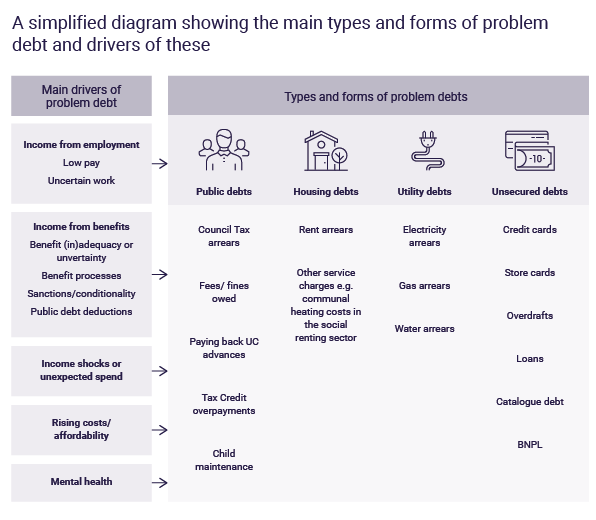
- Rent arrears, Council Tax debt and utility arrears are the most significant debt types, carrying severe and often rapid enforcement consequences that push households from financial strain into acute crisis
- Once homelessness has occurred, existing debts and the accumulation of new ones can entrench housing insecurity and delay or prevent recovery
- Debt rarely occurs in isolation — low-income renters typically manage multiple overlapping arrears, often forced to deprioritise rent not through poor financial management, but because the system demands impossible choices between essentials
- The relationship between debt and homelessness is cyclical: debt damages mental and physical health, reducing people's capacity to engage with landlords and services; homelessness in turn generates further debt through higher living costs and disrupted benefits
- Some groups face acute and distinct risks — people with disabilities, single parents, young people, and survivors of domestic and economic abuse experience debt pathways shaped by benefit inadequacy, income volatility and, in some cases, coerced or historic debts
- Targeted, downstream support alone cannot offset these structural risks in the absence of wider system reform
Recommendations in Brief
The evidence is clear that problem debt is not a peripheral issue but a central mechanism through which structural pressures translate into homelessness. Preventing homelessness therefore requires acting not only on housing, but on the systems that generate and manage debt.
At national level: addressing the structural drivers of debt and homelessness
- Increase the adequacy and stability of incomes, particularly for low-income renters facing volatile earnings and benefit deductions
- Align housing support with real rental costs, reducing structural shortfalls that drive rent arrears
- Reform public sector debt enforcement to incorporate affordability and vulnerability, moving away from approaches characterised by rapid escalation toward more sustainable resolution
Evidence on public sector debt collection raises concerns about approaches that rely on escalation without sufficient consideration of affordability or vulnerability. There is therefore value in testing how alternative enforcement approaches, and different balances of income support and debt reduction, affect both financial recovery and homelessness outcomes.
At local level: embedding prevention across systems
- Use integrated administrative data as an early warning system for housing risk
- Align revenue collection, welfare support and homelessness prevention around shared outcomes
- Prioritise early intervention and resolution, rather than escalation through enforcement
- Develop targeted approaches for groups facing the highest and most complex risks
Testing could usefully focus on how early warning systems translate into action, including the timing, intensity and form of intervention that most effectively prevents escalation.
For service delivery: making support accessible, timely and joined-up
- Integrate debt advice, housing support and income maximisation, reducing fragmentation
- Intervene earlier and more flexibly, before problems become entrenched
- Ensure services are accessible, trauma-informed and responsive to complexity
- Enable frontline staff to resolve problems collaboratively, rather than defaulting to enforcement pathways
Further evaluation would strengthen understanding of which models of integration and tailoring are most effective in improving housing outcomes.
For research and evaluation
The evidence base is strongest on why debt drives homelessness, and weaker on which interventions work best to prevent it. Research should therefore prioritise the testing of:
- data-led early warning and prevention approaches
- alternatives to standard enforcement models
- targeted debt relief as a prevention tool
- integrated service delivery models
A system-level shift
Across all levels, the evidence supports a shift from responding to crisis toward earlier, prevention-focused and system-aligned approaches. Delivering this will require not only policy and practice change, but a sustained commitment to learning what works, for whom, and at what cost.