Share This Project


Play for change: The role of sport in preventing homelessness before it starts
This report explores sport’s untapped potential as a strategic tool for preventing homelessness across the UK by engaging at-risk individuals early and building protective factors like resilience and social connection. It examines how sporting infrastructure serves as a trusted "gateway" to services and employment, while calling for better data, trauma-informed practices, and cross-sector collaboration to transform these fragmented activities into a coordinated national prevention strategy.
Findings in Brief
- Sport already contributes to homelessness prevention but its impact is under-recognised, inconsistently measured, and rarely integrated into national strategies.
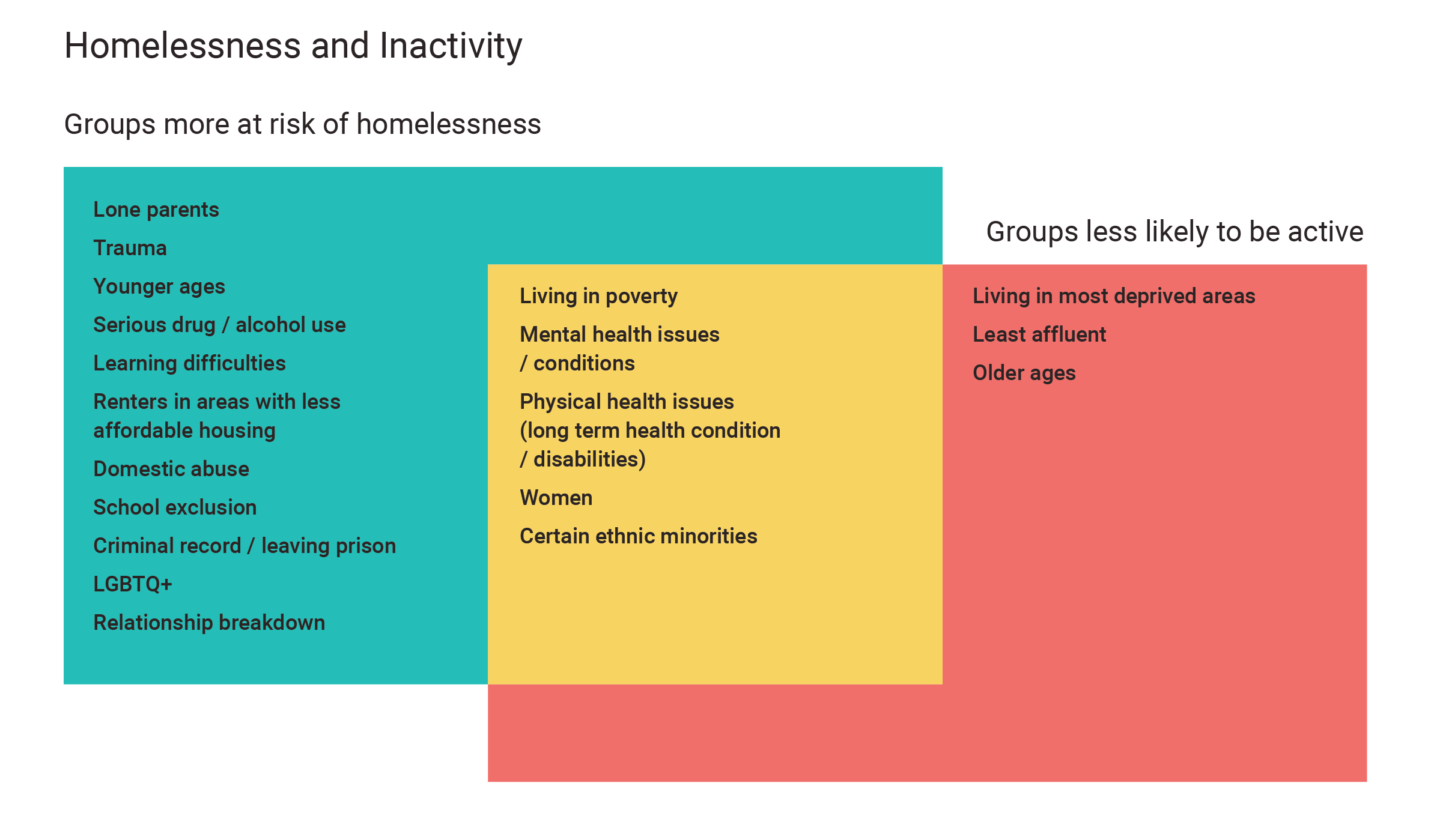
- The groups most at risk of homelessness substantially overlap with those least likely to be physically active, pointing to a significant and largely untapped prevention opportunity.
- Where evidence exists, it is promising. But the evidence base is small, fragmented, and dominated by qualitative, football-focused studies. No national framework links sport participation with housing outcomes.
- Sport can contribute through multiple pathways: as a gateway to services, a community hub, and a protective factor against crisis - as well as an employer. Wraparound support is essential as sport works best when it is part of a wider offer, not a standalone activity.
Recommendations in Brief
Policy makers
Develop shared data and metrics. For instance, link sport participation data with housing datasets. Establish shared outcome frameworks across sport, housing, and local authorities.
Policy makers and Programme Delivery Organisation
Build the evidence base. Commission more rigorous evaluation of sport-based prevention interventions, including longer-term outcome tracking and a living evidence map.
Clubs, foundations, and sport-for-development organisations
Embed inclusion and trauma-informed practice and co-design sports interventions with communities. Address structural barriers to participation. Train sports workers accordingly.
Local authorities and combined authorities
Integrate sport into prevention systems. Commissioners and local authorities should treat sport as a core component of prevention strategy, not an add-on.
Funders and commissioners
Coordinate investment. Bring together governing bodies, funders, and housing providers to share learning and scale what works.